How to Select a Drone Propulsion System: Motor, ESC, Propeller
How to size an integrated drone propulsion system: per-axis thrust, propeller and wheelbase, battery voltage, PWM/CAN and protection, with SIYI E3, D6, E6 and E8 compared.
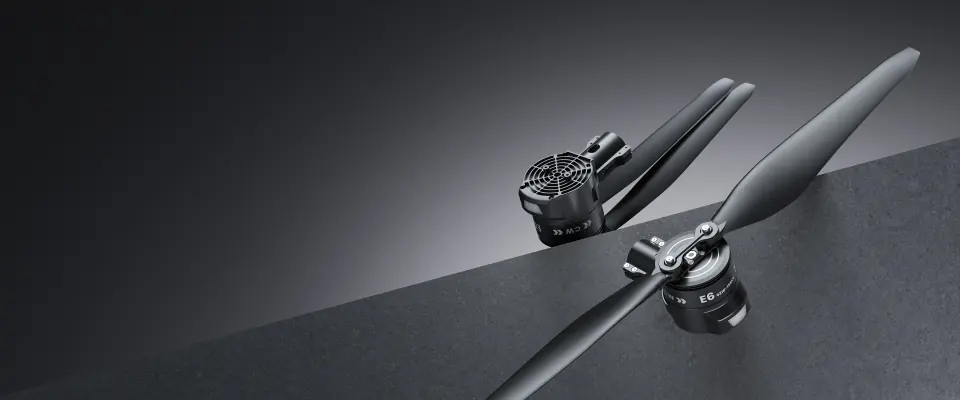
On a multirotor, everything in the air is carried by the propulsion system: motors, the electronic speed controllers (ESC) driving them, and propellers. An integrated propulsion unit supplies all three as one assembly, matched and tuned by one manufacturer and ready to mount on the arm.
Integrators choose such units because motor, ESC and propeller need not be selected, wired and tuned against each other, and the thrust data applies to the whole assembly. This guide explains the figures that matter when sizing a drone propulsion system for a UAV build and compares four SIYI models.
The figures that decide the choice
- Maximum thrust versus recommended take-off weight: maximum thrust is one unit's output at full throttle, but an aircraft needs reserve thrust to hold attitude, climb and resist gusts. The recommended take-off weight per axis therefore sits well below maximum thrust; E8 lists 18.5 kg against 5–8 kg, both single-axis. Size the aircraft on the recommended figure.
- Conditions behind the numbers: E6's thrust figures are stated at sea level and E3's maximum thrust at 16A. Thinner air reduces thrust, and SIYI's FAQ for E6 and D6 says full-throttle thrust falls as motor temperature rises.
- Propeller, wheelbase and arm tube: larger propellers need more distance between rotors. E3 is listed for a 600 mm - 700 mm wheelbase and E8 for ≥1200 mm; D6, E6 and E8 state the arm tube diameter they fit.
- Battery voltage and KV: KV is a motor's no-load speed per volt; large propellers pair with low-KV motors and higher-voltage packs. E3 is specified for 6S, the other three for 12–14S LiPo, which also sets the aircraft's power architecture.
- Control signal and FOC: PWM is the one-way throttle pulse; CAN is a digital bus that carries throttle and returns operating data. All four units accept both, so one can back up the other. With FOC, the ESC shapes motor current into a near-sinusoidal waveform that follows the rotor instead of switching it in coarse steps, giving smoother, quieter torque.
- Protection, temperature and weight: an IP code's first digit rates dust protection and its second water protection; X means not stated. E3 and D6 list IPX5, E6 lists IPX6 and E8's table prints IP6X, so confirm E8's water protection before planning wet work. Only E3 and E6 list an operating temperature; unit weights are in the table.
E3, D6, E6 and E8 compared
Values keep SIYI's units and conditions; a dash means none is published.
| Specification | E3 | D6 | E6 | E8 |
|---|---|---|---|---|
| Maximum thrust (single-axis) | 2.2 kg (16A) | 6.5 kg | 12.5 kg (at sea level) | 18.5 kg |
| Recommended take-off weight (single-axis) | 0.5~1 kg | 2 to 2.5 kg | 3-6 kg (at sea level) | 5-8 kg |
| Propeller diameter × pitch | 15.5 inch × 5.8 inch | 22 inch × 7.8 inch (straight) / 9 inch (foldable) | 24 mm × 9.0 mm (as printed) | 32*12.0" (as printed) |
| Motor KV | 350 rpm/V | 130 KV | 155 KV | 110 rpm/V |
| Recommended battery | 6S | 12~14S LiPo | 12-14S (LiPo) | 12-14S LiPo |
| Compatible wheelbase | 600 mm - 700 mm | - | - | ≥1200 mm |
| Arm tube diameter | - | 30 mm | Φ30 mm | φ40 mm |
| Ingress protection | IPX5 | IPX5 | IPX6 | IP6X |
| Operating temperature | -20~50 ℃ | - | -20~50 ℃ | - |
| Weight | Motor 120 g ± 1 g; ESC 46.5 g ± 0.1 g | 429 g (excluding propeller) | 825 g (with propellers) | 960 g (excluding propeller) |
Three source entries need confirming before design work: E6's propeller is printed in mm while the other kits use inches; E8's propeller is one 32*12.0" entry and its pitch row shows a weight; E6's weight is labelled 'excluding propeller' but marked 'with propellers'.
Reading the table for different airframe sizes
- Compact frames: E3 fits a 600 mm - 700 mm wheelbase on 6S with a 15.5 inch folding propeller. SIYI positions it for portable industrial drones and aerial filming platforms.
- Mid-size enterprise multirotors: D6 takes a 22 inch straight or foldable propeller on a 30 mm arm tube and a 12~14S pack.
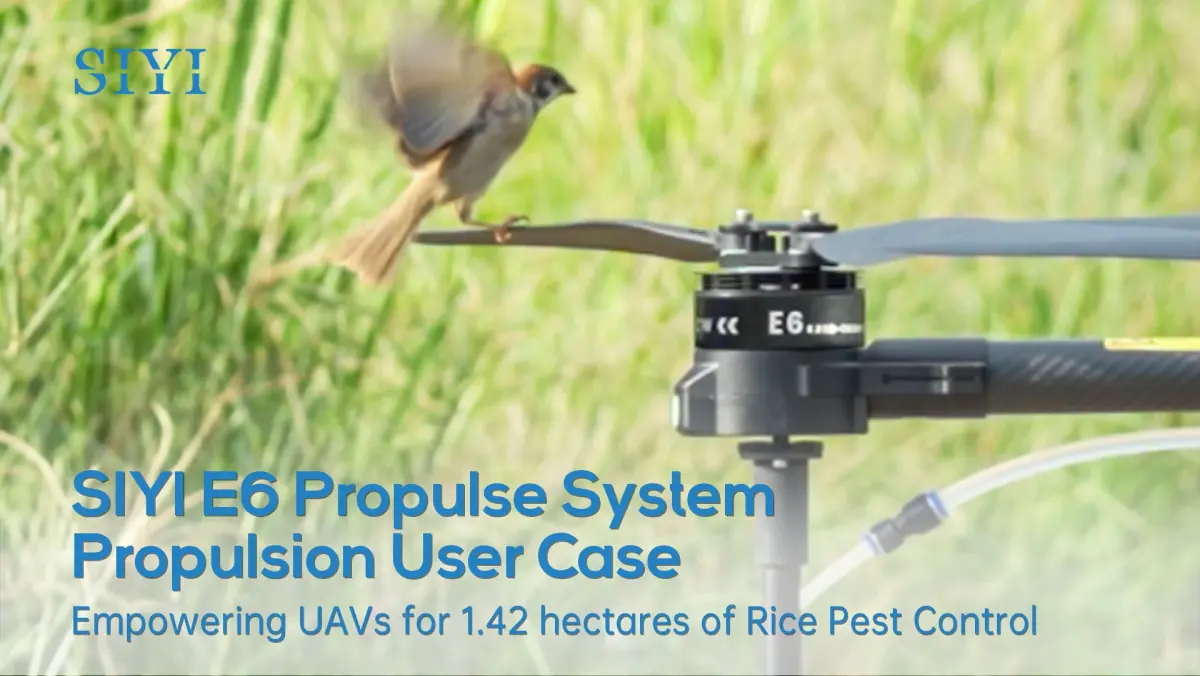
- Larger enterprise and farm aircraft: E6 lists IPX6, and SIYI recommends it for enterprise and agricultural drone platforms whose take-off weight stays under 6 kg per rotor.
- Heavy-lift airframes: E8 needs a ≥1200 mm wheelbase and a φ40 mm arm tube, the class of aircraft considered for carrying loads on construction sites.
To check a design, divide the planned take-off weight by the rotor count and compare the result with a kit's recommended range. For setup, SIYI's FAQ for E6 and D6 describes connecting the CAN cable through the CAN LINK module to adjust settings and read logs in UniGCS.
Next steps
Compare the four units on the compare page or shortlist them in the product finder, then contact us with planned take-off weight, rotor count, battery voltage and arm tube diameter so we can confirm the match.
Frequently asked questions
Why is the recommended take-off weight lower than the maximum thrust?
Maximum thrust is a unit's full-throttle output, while an aircraft needs reserve thrust for control, climbing and wind. Plan the aircraft on the recommended per-axis take-off weight, not on maximum thrust.
Do SIYI propulsion systems accept both PWM and CAN throttle?
Yes, E3, D6, E6 and E8 all list PWM and CAN, so one signal can back up the other. SIYI's FAQ for E6 and D6 states that PWM has priority over CAN.
Which battery do the E3, D6, E6 and E8 need?
E3 is specified for 6S. D6, E6 and E8 list a recommended battery of 12–14S LiPo.