Industrial Drone Controller Guide: Ground Stations and Data Links
How to choose between a handheld ground control station and a standalone datalink, and how to read range, frequency, screen and interface figures on SIYI spec sheets.
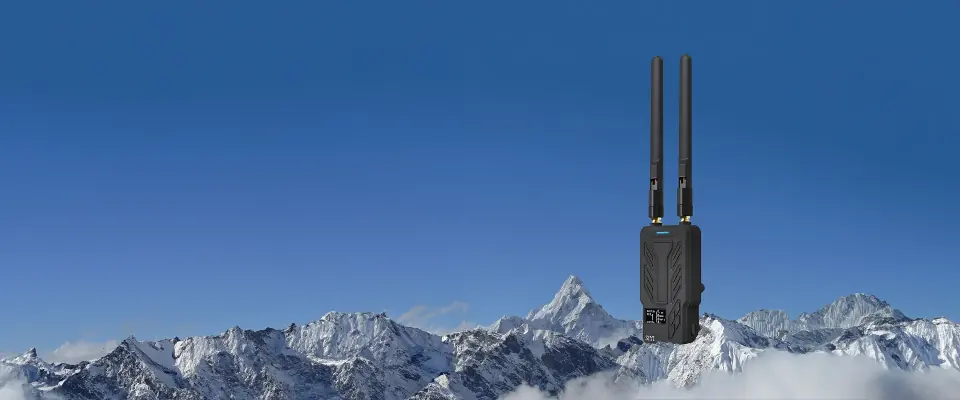
Every remotely operated vehicle depends on its data transmission system: a radio link between a ground unit with the operator and an air unit on the vehicle. It carries control commands up, telemetry back and, on most systems, live video from the payload, and it limits how far the vehicle can work.
SIYI's link and controller range falls into two groups: handheld ground control stations, often described as industrial drone controllers, and standalone datalinks. This guide explains when each fits and how to read the manufacturer's specification tables.
Handheld ground station or standalone datalink
A handheld ground station is a complete operator position. The UniRC 10 Pro, UniRC 7 Series, MK32, MK15 Enterprise and MK15 Agriculture each combine an Android system, a built-in monitor and physical controls, and work with an air unit that outputs 16 channels of S.Bus and 5 channels of PWM. They suit teams that want one device to carry on site and run ground control software on.
A standalone datalink suits integrators who already have a controller or a laptop ground station. The HM30 combines remote control, telemetry and video in one link and accepts S.Bus or PPM from an external controller. The DK32S is a compact remote controller with its own 2.4 GHz datalink. The 2.4G Datalink is a pair of radio units linking a flight controller's UART port to a ground station over UART or USB.
The decisions that matter
- Range and its conditions: a range figure means little without the altitude, obstruction and interference it was quoted under. SIYI quotes the UniRC models under several conditions and the MK models under one, so the numbers are not directly comparable.
- Frequency bands: the UniRC 10 Pro table lists 2.4 GHz and 5.8 GHz and notes that other bands require certification of the complete system under local regulations. In the UniRC 7 Series, only the Pro adds a 5.725–5.829 GHz band.
- Screen size and brightness: monitors range from 5.5 to 10.1 inches. For outdoor use, compare the brightness row as well as the size.
- Physical channels: count the sticks, switches and buttons that the vehicle and its payload need. The UniRC tables itemise each control; the MK tables give a total.
- Interfaces: check HDMI and Ethernet on the ground unit, and UART and Ethernet on the air unit for the flight controller and cameras; the UniRC air units have two of each. HDMI output is on every model except the standard UniRC 7 and the MK15 Agriculture.
- Ingress protection: IP54 for the UniRC models, IP53 for the MK15 and IP4X for the MK32.
- Battery endurance: from approximately 5 hours (UniRC 10 Pro, internal plus external battery) to 13 hours (MK15).
- Dual-operator control: SIYI describes two ground units sharing one air unit, one for the vehicle and one for the payload, on the UniRC 7 Series, MK32 and HM30. The MK15 Enterprise needs the dual combo; the UniRC 10 Pro lists it as a later release.
Specifications side by side
| Specification | UniRC 10 Pro | UniRC 7 Series | MK32 | MK15 Enterprise | MK15 Agriculture |
|---|---|---|---|---|---|
| Range at agriculture spraying altitude (3–6 m) | - | 3–6 km | - | - | 3.5 km (unobstructed, free of interference) |
| Range at 120 m altitude, few obstructions, medium interference | 20–25 km | 10–15 km (rural area) | - | - | - |
| Range above sea, no obstruction, low interference | 35–45 km (120 m altitude) | 30–40 km (150 m altitude) | - | - | - |
| Range unobstructed, free of interference (no altitude stated) | - | - | 15 km | 15 km | - |
| Frequency | 2.4 GHz / 5.8 GHz | UniRC 7 Pro: 2.400–2.476 GHz and 5.725–5.829 GHz; UniRC 7: 2.400–2.476 GHz | - | - | - |
| Screen size | 10.1 inch | 7 inch | 7 inch | 5.5 inch | 5.5 inch |
| Brightness | 2000 nit | 1600 nit | - | - | - |
| Physical channels | 13 buttons / 6 three-position switches / 2 main joysticks / 2 mini joysticks / 2 dials / 2 knob switches | 10 custom buttons / 6 flight mode buttons / 2 main joysticks / 1 sub joystick / 2 dials / 2 three-stage switches | 16 | 13 | 13 |
| Endurance | Approximately 5 h (external + internal battery) | UniRC 7 Pro: approx. 8 h; UniRC 7: approx. 11 h | 10 h | 13 h | 13 h |
| IP level | IP54 | IP54 | IP4X | IP53 | IP53 |
| Weight | 2600 g (including belly rest bracket) | UniRC 7 Pro: 1.46 kg; UniRC 7: 1.44 kg | 1440 g | 850 g | 850 g |
Range values are SIYI's figures for the condition named in each row; a dash means the specification table gives no value. The MK tables omit brightness (product descriptions state a maximum of 1000 nit) and frequency (SIYI's FAQ places the MK32 on 5 GHz, the MK32E on 2.4 GHz).
| Specification | HM30 | DK32S | 2.4G Datalink |
|---|---|---|---|
| Max transmission range | 20 km (unobstructed, free of interference) | 20 km (unobstructed, free of interference) | 30 km (unobstructed, free of interference) |
| Frequency | - | 2400 ~ 2483 MHz | 2400 ~ 2483 MHz |
| Channels | 16 communication channels | 16 physical channels / 16 communication channels | - |
| Ground unit display | 0.96-inch OLED display | 2.8-inch high-brightness colour LCD, capacitive touchscreen | - |
| Air unit signal output | 16 channels of S.Bus / 5 channels of PWM | 16 channels of S.Bus / 8 channels of PWM | - |
| Air unit weight | 74 g (109 g with 4S to 18S power module) | 33 g (antenna excluded) | 28 g |
The HM30 table states no frequency. The 2.4G Datalink table gives 30 km while SIYI's product description cites 15 km, so confirm which figure applies to your configuration.
Reading the tables for your platform
- UAV: pick the row that matches the flight profile. At an agricultural spraying altitude of 3–6 m the UniRC 7 Series is listed at 3–6 km and the MK15 Agriculture at 3.5 km, well below the 120 m and 150 m figures.
- UGV and USV: the antenna stays near the ground or water, so treat the low-altitude rows as the closer reference; the above-sea figures refer to flight at 120 m or 150 m, not to a boat. SIYI's FAQ says the MK15 Agriculture focuses on ground-to-ground range and the MK15 Enterprise on ground-to-air range.
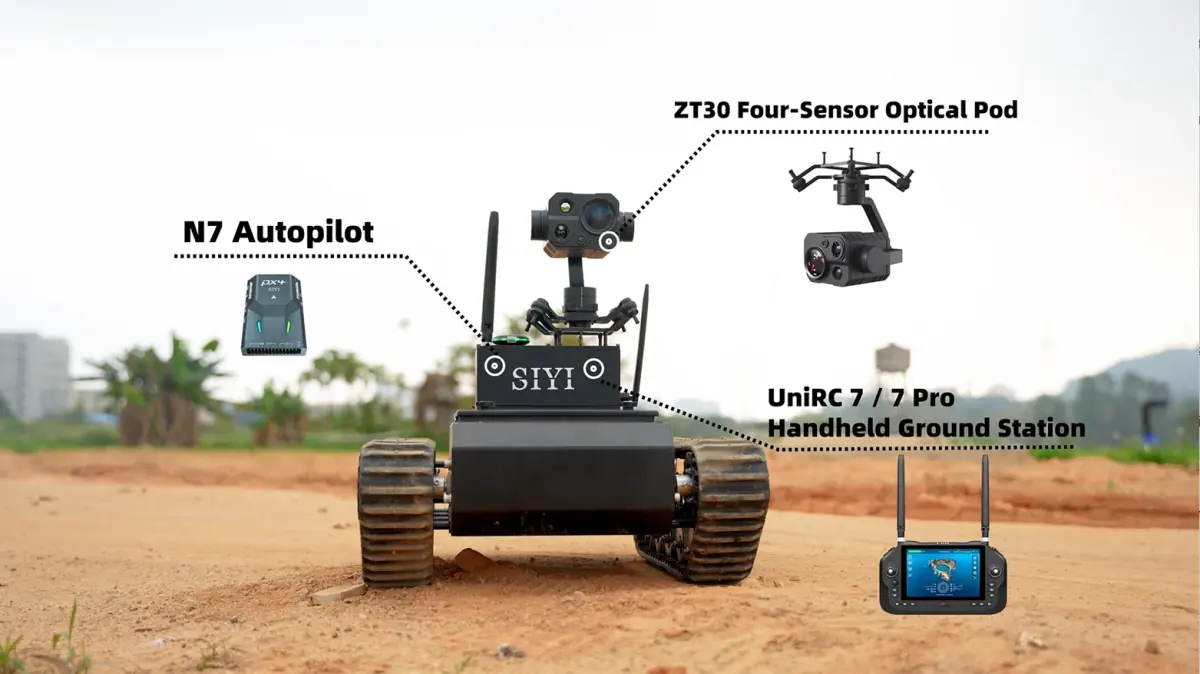
- Robots and multi-payload vehicles: the UniRC 10 Pro adds two mini joysticks to the main pair, and the DK32S table lists UGV, USV and smart robotics as compatible.
Next steps
Put shortlisted models side by side on the compare page, narrow the choice with the product finder, or contact us with your vehicle type, working distance and payload so we can help match a link.
Frequently asked questions
What is the difference between a handheld ground station and a standalone datalink?
A handheld ground station combines the screen, controls and radio link in one device that works with an air unit. A standalone datalink such as the HM30 or 2.4G Datalink adds a link to a controller or ground station you already use.
Why do range figures differ so much between models?
Each figure is quoted under its own condition. The UniRC 7 Series, for example, is listed at 3–6 km at agriculture spraying altitude (3–6 m) and at 30–40 km above sea at 150 m altitude with no obstruction and low interference.
Which SIYI links support dual-operator control?
SIYI describes dual-operator control for the UniRC 7 Series, MK32 and HM30. The MK15 Enterprise needs the dual combo, and the UniRC 10 Pro lists the function as a later release.